


York Against Cancer research uncovers important clue in the battle against prostate cancer
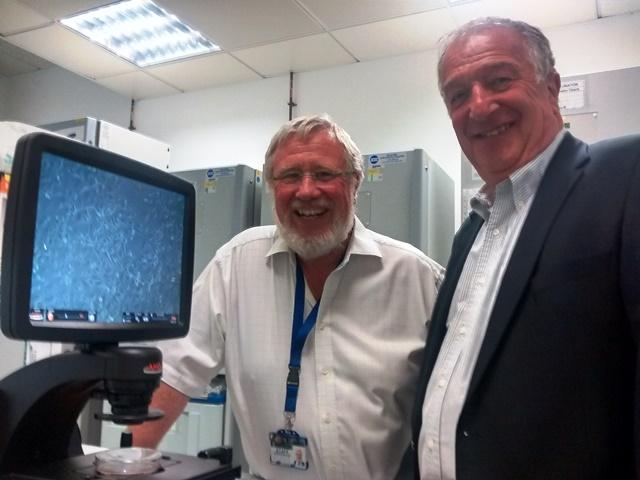
PICTURE: Professor Maitland with out founder, Professor Steven Leveson, when funding for the research was announced in 2015
Scientists in York have unlocked a way that prostate cancer can return after treatment – and the discovery could radically improve the way we tackle the condition.
In collaboration with Dr Deborah O’Connell in the York Plasma Institute, Professor Norman Maitland’s laboratories at the University of York have identified a mechanism which causes plasma therapy or radiotherapy to fail, with cancer cells regenerating after treatment.
The £100,000 study funded by a bequest to York Against Cancer saw Dr John Packer minutely studying a process known as the Notch response, in which he found that signals were trying to prompt cells to grow again immediately after radiotherapy.
“The good news for patients is that this doesn’t happen all the time, however – if you give a high enough dose of radiotherapy it will overcome this response and cure the cancer,” said Professor Maitland.
“When a prostate cancer cell gets hit by radiotherapy or plasma therapy, nobody really knew exactly what happened.”
The team designed experiments to observe prostate cancer cells every two hours, discovering that the Notch response followed on from a powerful anti-oxidative response and was triggered between four and eight hours after treatment. By 72 hours after treatment, the targeted cells were either dead or growing again.
“I like to compare a cancer cell to the walled city of York, where the castle keep is the cell nucleus and the walls are the outer membrane of a cancer cell. The nucleus is where the big decisions are taken, said Professor Maitland. “Just like a soldier on the walls of York who sees invaders coming, the antioxidant response kicks in very quickly, trying to stop the attack. If the attack is too heavy the soldier sends a demand to the castle keep saying, ’We are under attack and you need to send some strong armoured knights to defend the city.’
“John found that this second strong response was due to the powerful cellular function called Notch. It was present in both normal and cancer cells and it’s how a cell population can regenerate itself after radiotherapy.”
Dr Packer also discovered that while most cancer cells were likely to be killed off by radiotherapy, the Notch response could kick-start growth in a small number of cancer stem cells that do not normally grow, resulting in regeneration of both cancer and normal tissues.
“The implication is that if you were able to treat cells with both an inhibitor of Notch and radiotherapy you would stop the regenerating response,” said Professor Maitland. “That’s precisely what we were able to do. It is one of the cleverest pieces of research that we have done in my 28-year career in York.
“Radiotherapy and, potentially, Low Temperature Plasma are really effective ways to kill cancer cells. The problem always is that a proportion of the cancers relapse. By unpicking the responses of cells from men with prostate cancer in Yorkshire we have unearthed a solution.”
Dr Packer’s paper has been published by FEBS Letters, the scientific journal of the European Biochemical Society.
The publication should pave the way for clinical trials, which could take place more quickly than usual because the drugs used in the lab tests are chemotherapy agents already approved for use in humans.
Professor Maitland said that while the research had concentrated on prostate cancer cells, it could also have ramifications for other common cancers such as breast cancer, although a slightly different response had resulted from research on breast cancer cells.
John Packer was funded through a bequest from a local farmer who requested in his will that £100,000 of his legacy to York Against Cancer should be used on prostate cancer research. Further funding for the plasma research and prostate cancer treatment studies was supported by project grants from the Engineering and Physical Sciences Research Council, Prostate Cancer UK and Cancer Research Technology (CRUK).
Ian Yeowart, chair of York Against Cancer, said: “The continuing research funded by our charity remains vital in the battle to fully understand and treat cancers of all types, and bequests are an important element in helping us to provide the resources needed for this vital research.
“Professor Maitland has been a tireless worker in this field, and we wish him a long and well-deserved retirement.”