


India trip sparks possible international cancer study

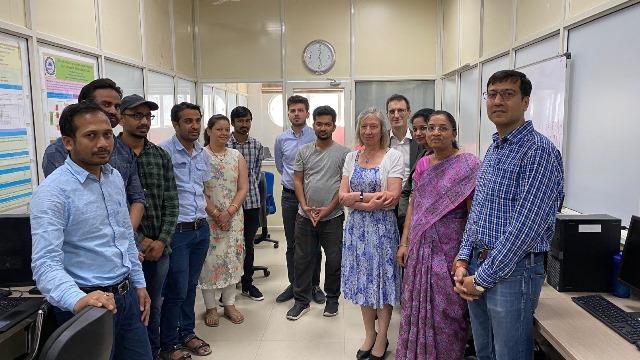
Photos by Vlad Ungureanu, a research assistant from the University of York, who took part in the visit.
The scientist who leads York Against Cancer’s research into bladder cancer has travelled to India in pursuit of a possible international study into the causes of the disease.
Professor Jenny Southgate, of the University of York’s Jack Birch Unit, and her colleague Professor Steve Smith of the University’s Department of Electronic Engineering met fellow experts from several of India’s leading institutions during a mission to the country in February.
The meetings they held uncovered a possible area for collaboration with scientists in India to study how industrial ground contamination may cause bladder as well as other cancers.
Professor Southgate and Prof Smith, an expert in data analysis using artificial intelligence and machine learning, conducted their India mission with funds from the Government’s Global Challenge Research Fund.
They visited the capital, Delhi, where they had the chance to visit the All India Institute of Medical Science (AIIMS), ranked as the top medical school, hospital and medical research university in South Asia in 2019.
They also visited the city of Indore, home to one of the eight highly regarded Indian Institutes of Technology (IIT), which specialises in information technology and artificial intelligence.
While at AIIMS, they learned about ongoing research looking at association between arsenic contamination of groundwater and incidences of bladder and other cancers in certain regions of India, and the idea for a possible collaboration was born.
“We have found that researchers in India haven’t yet started collecting cancer specimens to examine which genes are involved,” said Prof Southgate. “Our idea is to get them set up to collect this data, because we suspect that in Yorkshire there is also an industry-related increase in cancer. We are very interested to compare between India and Yorkshire where there might be different genetics and exposures to different types of geo-environmental risk.”
During the trip to India, the scientists had the chance to visit a cancer hospital, where Professor Southgate was impressed by the attitude of the senior medical staff towards their patients.
“It was quite amazing,” she said. “It was incredibly busy and crowded, but the consultants were responding to any patient that needed help as they were walking through the corridors. They were getting down on their knees and helping the patients – it was quite a different approach, much more organic and less formalised than we are used to.”
Before their return the York scientists also attended a University of York agency to meet prospective students and answer their questions.
Now that the academics are back in the UK, Professor Southgate said further future meetings were being discussed, to take place after the current coronavirus pandemic.
At the Jack Birch Unit, the collaboration would involve her deputy, Dr Simon Baker, as well as Dr Andrew Mason, a data scientist whose appointment has also been supported by York Against