


Looking for clues in the fight against bladder cancer
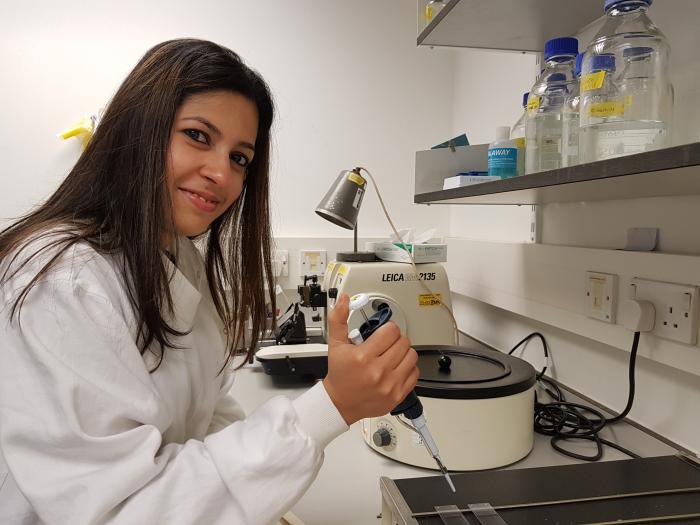
PICTURE: Dr Sreemoti Banerjee at the Jack Birch Unit
A study at the Jack Birch Unit is analysing how cells adapt to changes in their local tissue environment to help understand how cancers can develop. The work could lead to the development of improved treatments for bladder cancer, the disease on which much of the research in the Jack Birch Unit concentrates.
Dr Sreemoti Banerjee, a researcher at the unit, is searching for a phenomenon known as “cellular plasticity” in urothelium, the tissue that gives rise to bladder cancer. “Bladder cancer is the 10th most common occurring cancer worldwide and the sixth most common in men, but it is relatively little studied and treatments have not improved in the last 20 years,” she said. She said that conventional cancer therapies worked by targeting tumour cells as they divide. This causes tumour shrinkage, but often tumours can regrow long after the treatment has finished. “Some scientists suggest that conventional treatments fail because of the existence of so-called cancer stem cells,” said Dr Banerjee. “Normal stem cells are slow dividing cells involved in tissue repair. If cancers have their own stem-like cells, then it is important to design therapies that destroy these hidden cells.”
Dr Banerjee said that a complicating factor was the possibility that cancer cells could revert to become cancer stem cells and give rise to another tumour. “The idea that cells adapt to changes in their local environment is referred to as cellular plasticity,” she said. “We are really interested in this cellular plasticity model.” Dr Banerjee said her work involves isolating different cell types from within human urothelium to identify which genes are switched on or off in the different types. “No stem cells have yet been found in urothelium, but we have seen that normal urothelium can regenerate itself. Our hypothesis is that urothelial cells use cellular plasticity; so once the tissue is damaged, the individual cells are forced to adapt. By altering the environment, can we cause cells to switch their properties?” she said. “If we better understand if cellular plasticity rather than stem cells is involved in urothelial tissue repair, the hope is we and others will be able to design better targeted therapies for bladder cancer.”
Students in profile
The Jack Birch Unit regularly hosts students working on projects as part of their academic studies. Here, we profile two recent JBU students.
Natasha Leese
Natasha Leese is an undergraduate student at the University of York studying for an integrated Masters in Biology. Her third year of study is focusing on cancer cell and molecular biology.

Natasha was awarded a competitive Biomedical Vacation Scholarship from the Wellcome Trust to work in the Jack Birch Unit over the summer. Natasha investigated whether a rare ‘neuroendocrine’ cell type exists in healthy bladder epithelium. These cells could be where aggressive neuroendocrine tumours start life.
Beth Swan
Beth Swan is an undergraduate student studying Molecular Cell Biology at the University of York. She has a particular interest in cancer biology and hopes eventually to study for a PhD in the subject.

Beth was funded by York Against Cancer as a summer student. She studied a protein called ZO-3, which helps form the junctions between the cells that line the bladder. These junctions are essential to the integrity of the bladder lining and not only prevent urine leaking into the underlying tissues, but may be involved in suppressing cancer growth. Beth studied what happens to bladder cells when she ‘knocked down’ (reduced) ZO-3 and how this affects the ability of the tissue to repair.