


A JBU research update
Tom Crighton
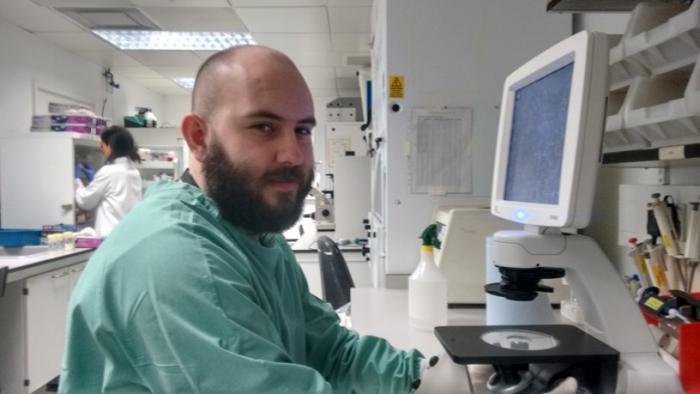
One of our PhD students, Tom Crighton, has very nearly finished his doctoral research at the Jack Birch Unit. Below is a brief description about Toms topic of research. A huge well done to Tom for all his hard work, we wish you the best of luck with your future endeavours!
Cancers arise from mutations of genes that help the cells of the human body to remain in its normal, healthy state. Our team at the Jack Birch Unit specialise in the study of the urothelium, a layer of cells that line the bladder and connecting urinary tract. Urothelial cells are specialised to provide a physical defence against harmful toxins found in urine, but damage to the DNA of these cells can lead to urothelial carcinoma, the most common form of bladder cancer. Funded by York Against Cancer, I undertook a PhD studentship that aimed to identify proteins found within urothelium that have an effect on how the cells function. A related group of proteins, also known as a signalling pathway, will act in a co-ordinated and reproducible manner in response to specific signals that the urothelium receives. Certain signalling pathways may therefore function differently (or be lost entirely) when a cell transitions from a normal to a cancerous state.
Through the course of my PhD I focussed on two signalling pathways, the Sonic Hedgehog and Hippo pathways, which had not previously been studied in adult human bladder cells but had been implicated in the onset of other cancers. I determined that some parts of the Sonic Hedgehog pathway were expressed by urothelial cells, but other proteins in the pathway were only expressed in the supportive network of cells surrounding the urothelium called the stroma. I demonstrated that it is possible to activate the pathway in stromal cells using drugs that mimic the urothelial side of the pathway, suggesting that the two cell types may interact with one another using this pathway in normal circumstances but subsequently lose the ability to ‘converse’ in cancer. I additionally identified a rarely studied protein of the Hippo signalling pathway called VGLL1 that is highly expressed by urothelial cells. This protein appears to have an important role in stopping normal cells from dividing and growing, while its expression is lost in the most highly invasive bladder tumours, marking VGLL1 as a highly important protein in maintaining the normal characteristics of the urothelium. This exciting discovery could be used as a basis to produce a drug that mimics how VGLL1 works to potentially impede the spread of certain invasive bladder tumours.
Overall I have thoroughly enjoyed my time at the JBU; completing a research project that has been made possible through the generosity of York Against Cancer. I have presented my findings at conferences in both the UK and abroad, while I am now in the process of completing my PhD thesis and preparing manuscripts so that my research can be published in a peer-reviewed journal.