


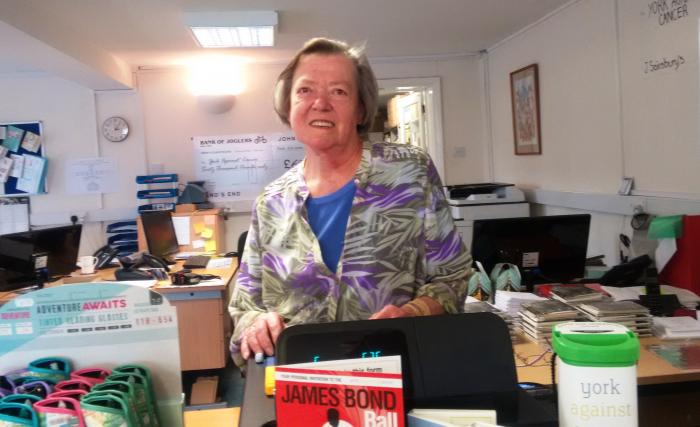
In Mouth Cancer Action Month, our volunteer Di shares her story
One ordinary day in August 2004, Di Ridley felt a tickling sensation in her mouth. Irritated by the feeling, she looked in her mirror and noticed something that would change her life forever.
“I saw a tiny, tiny bit of white skin on the top of my mouth, smaller than my little fingernail…and my fingers are small,” she recalls.
Di’s husband Bernard was away for a few days, but when he came back they called their GP and Di went along. “The doctor took one look and said, ‘We don’t like white marks in mouths – I am going to refer you.’”
After that, says Di, things moved very fast. She went along to the maxillofacial department at York Hospital for preliminary tests. “It was on the 22nd of September that the doctor told me it was cancer – I can remember giving a little scream.”
A kind-hearted specialist nurse introduced her to a man who had recently had the surgery that Di would need, and she took comfort and reassurance from the conversation. “She was lovely, that nurse,” she remembers.
A biopsy under general anaesthetic followed on October 1 and on Wednesday October 13 Di had her operation.
It was forecast to last 12 hours but in the event took slightly less. Di remembers nothing from having a shower at 6am on the morning of the surgery until 6pm of the following day, when she awoke in intensive care.
She stayed in hospital for a fortnight. She was swollen and unable to speak at first, but her pain was well controlled and after 10 days a nurse removed a tracheotomy tube from her throat.
The next day her surgeon arrived on his round accompanied by medical students. “He sat down on the bed and said to me, ‘I want you to say hello to everyone in this room,’ and I just went, ‘Hello!’.
“I did have a speech therapist but it didn’t last long because I was doing so well.”
Back home, Di started to adjust to her new life, trying to see what food she was able to eat. “I think Bernard got sick of the sight of fish!” she says.
“I was told I would probably never be able to wear dentures again, but I said, ‘Just watch me!” I got my top set in after a while but it was 12 months or more before I could wear a bottom set. My face was quite twisted – I thought I looked as if I had had a stroke. I had to wait for my nerves to heal – they are very slow to regrow.”
The good news was that Di’s cancer had gone and only one lymph node had shown any sign of it. “They felt they had got everything, and that there was no need for radiotherapy or chemotherapy.”
Di continued to be monitored, at first monthly, then every three months and eventually every six months until one day, her doctors said she no longer needed to be watched. “I am on a promise that if ever I feel concerned, I can ring my Consultant’s secretary and he will see me.”
Thankfully, since that day in 2010 Di has been fit and well. Within months of her surgery, she started to volunteer for York Against Cancer, a charity she knew through her friendship with our founders Professor Steve Leveson and his wife, Pat.
She remains a regular helper for the charity and has shared her story with us in the hope that, in Mouth Cancer Action Month, it might spread the word about a lesser-known condition to the wider public.
“If you notice something, anything that concerns you, get it checked out,” says Di. “I can remember thinking, ‘Why me?’ and then thinking, ‘Why not me?’ It can happen to anybody.”
Symptoms of mouth cancer include:
* Painful mouth ulcers that don’t heal after several weeks
*Unexplained persistent lumps in the mouth or neck that don’t go away
*Unexplained loose teeth or sockets that don’t heal after extractions
* Unexplained, persistent numbness or an odd feeling on the lip or tongue
* Sometimes, white or red patches on the lining of the mouth or tongue. These can be early signs of cancer, so they should also be checked
*Changes in speech, such as a lisp
Talk to your GP or dentist if these symptoms do not get better within three weeks, particularly if you drink or smoke.
Find out more about mouth cancer here.